
The Food and Drug Administration (FDA) has warned the public about the next potential phase of the opioid epidemic, which has affected millions of people in the United States. This “fourth wave” is characterized by the emergence of novel synthetic opioids. One substance of growing concern is “7-OH”. This edition of Clinical Insight provides information about what 7-OH is, its desired effects, and associated risks and adverse outcomes.
What is 7-OH?
- Kratom is a tree native to Southeast Asia whose leaves have been consumed for centuries for their dose-dependent stimulant and opioid-like effects. Mitragynine is the primary substance in kratom that contributes to its effects. 7-Hydroxymitragynine, or 7-OH, is also a natural part of the kratom plant, but makes up less than 2% of the total content in kratom leaves.
- Even though it is present in small amounts, 7-OH exhibits significantly greater potency on opioid receptors in the body than mitragynine, as well as other opioids, such as morphine. It is estimated to be approximately 10 times more potent than mitragynine and up to 13 times more potent than morphine.
- 7-OH’s strong effect on opioid receptors is believed to play a major role in kratom’s pain relieving and other desired effects.
How is 7-OH supplied?
- Marketed as herbal supplements, these products are being synthetically produced and contain highly concentrated amounts of 7-OH. A public alert from the FDA reported that they may contain up to 500% more 7-OH than what is found naturally in kratom leaves.
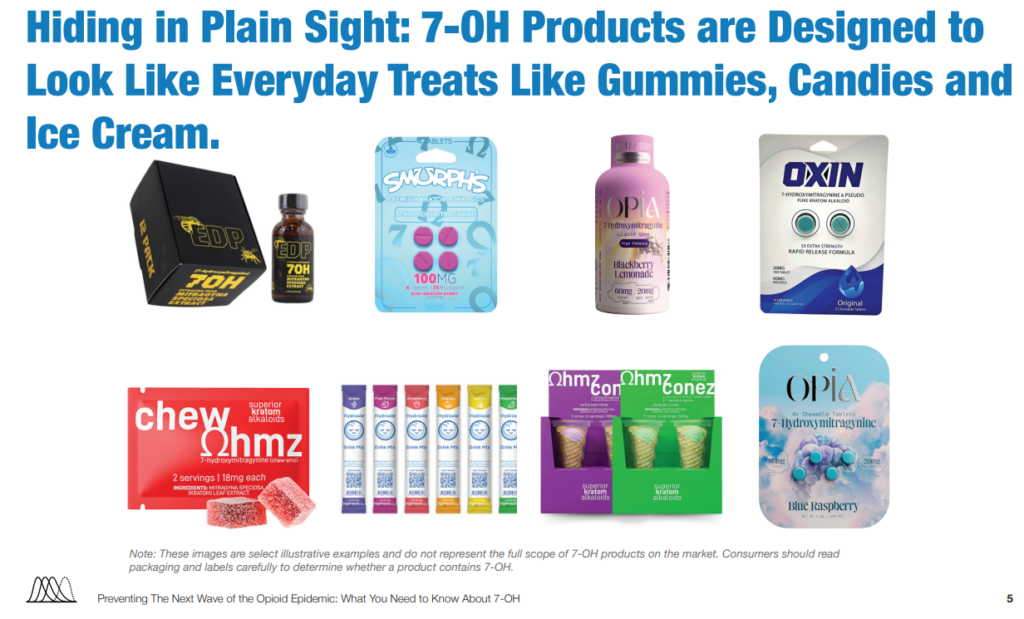
- 7-OH products are available in many forms, including chewable tablets, concentrates, extracts, edibles (e.g., gummies, ice cream cones), and beverages, such as drink mixes, shots and syrups.
- These products can be easily purchased online or in gas stations, smoke shops or convenience stores.
- Many of these products are marketed as “kratom extract” or “enhanced kratom”, while others are deceptively labeled as kratom despite containing dangerous amounts of 7-OH.
- Street names include 7-Hydroxy, 7-OHMG and ‘7’.
What are the uses and desired effects of 7-OH?
- Individuals may use 7-OH as an alternative to opioids, for pain and anxiety relief, to treat depression or insomnia, or to self-manage or taper from an opioid addiction.
- Some of its desired effects include euphoria, mood elevation, relaxation, sedation, and pain relief.
- Since it is often marketed as a ‘natural” opioid substitute, users may mistakenly believe these products to be safer than prescription opioids. However, these products are unregulated, may contain unknown contaminants, and the actual 7-OH content present may produce effects more similar to morphine or fentanyl than to kratom.
Does 7-OH cause adverse effects?
- Common adverse effects from use of this drug include agitation, tremors, increased heart rate, excessive sweating, high blood pressure, sedation, confusion, agitation, nausea, vomiting, trouble breathing, and seizures.
- In more serious cases, respiratory depression, coma, or death have been reported, especially if used in combination with other drugs or alcohol.
- 7-OH carries a high potential for addiction, and current evidence suggests it may be as addictive as opioids.
- Regular use of 7-OH can lead to tolerance and dependency, and individuals may experience withdrawal symptoms when discontinued. These symptoms can mimic those associated with opioid overdose or withdrawal.
- Naloxone, an opioid reversal medication, should be effective in a 7-OH overdose due to the activity of 7-OH at the opioid mu receptors. However, 7-OH products may contain other substances that may not respond effectively to naloxone.
7-OH Detection time
- Studies in humans are limited, therefore the detection time in human urine is unknown at this time.
Sources:
U.S. Food and Drug Administration. (2025). 7-hydroxymitragynine (7-OH): An assessment of the scientific data and toxicological concerns around an emerging opioid threat (FDA Center for Drug Evaluation and Research). https://www.fda.gov/media/187899/download
Kruegel AC, Uprety R, Grinnell SG, etal.. 7-Hydroxymitragynine Is an Active Metabolite of Mitragynine and a Key Mediator of Its Analgesic Effects. ACS Central Science 2019 5 (6), 992-1001.
U.S. Food and Drug Administration. (2025). Preventing the next wave of the opioid epidemic: What you need to know about 7-OH (PDF). https://www.fda.gov/media/187913/download
U.S. Food and Drug Administration. Hiding in Plain Sight, 7-OH Products. 2023. U.S. Department of Health and Human Services, https://www.fda.gov/media/187900/download.
Makary, M. (2025, July 29). Beware: Synthetic kratom — 7-OH — is powering a new opioid crisis. New York Post. https://nypost.com/2025/07/29/opinion/beware-synthetic-kratom-7-oh-powers-a-new-opioid-crisis/
U.S. Food & Drug Administration. (2025, July 29). Dear Colleague letter on 7-hydroxymitragynine (7-OH). https://www.fda.gov/media/187898/download
Krotulski, AJ; Denn, MT; Brower, JO; Papsun, DM; Logan, BK. (2025) Evaluation of Commercially Available Smoke Shop Products Marketed as “7-Hydroxy Mitragynine” & Related Alkaloids, Center for Forensic Science Research and Education, United States
Related
Discover more from Dominion Diagnostics
Subscribe to get the latest posts sent to your email.